Intelligence needs
a place to live.
The local-first, explainable open-source memory engine for embedded Rust applications and AI agent systems, with judged recall quality, reviewable synthesis proposals, append-only memory changefeeds, operator graph inspection, and time-travel recall for debugging what an agent knew when.
A living brain for inspectable recall.
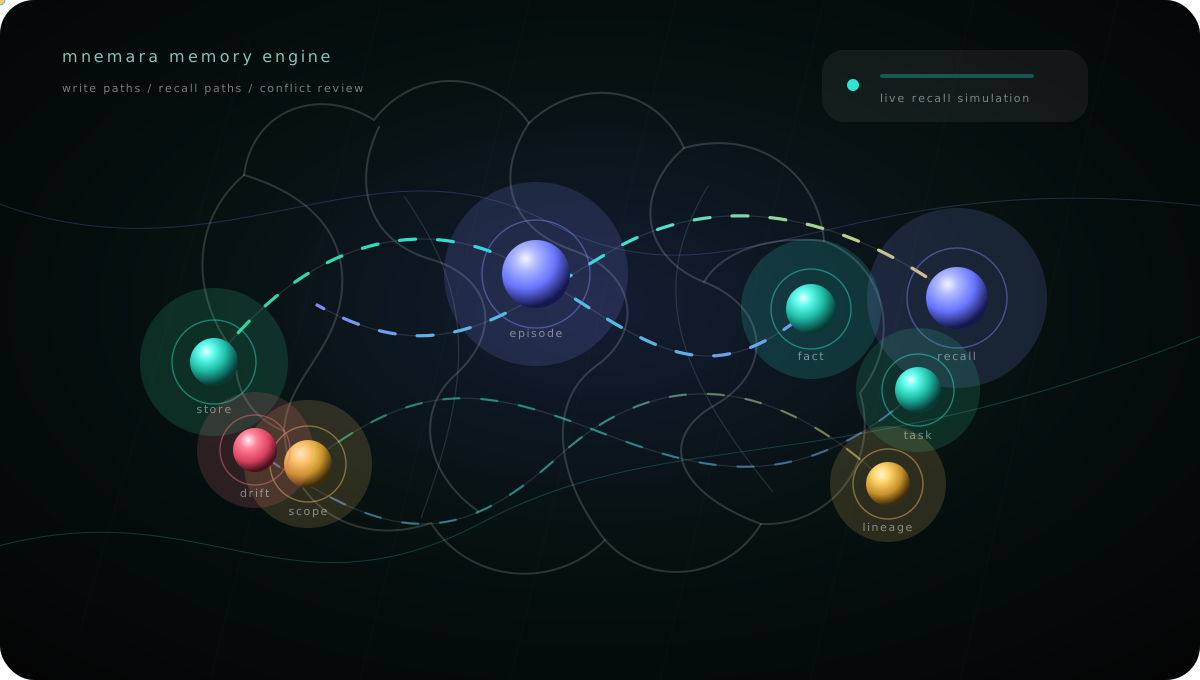
Watch Mnemara store memory as luminous write paths, connect episodes through lineage and scope, then retrieve context across the same traceable network.
Built for Recall.
Explainable Recall
Mnemara doesn't just return results. Every recall query provides per-hit score breakdowns, scorer family and profile selection, planning traces with planner stages, candidate sources, graph relation reasons, filter reasons, and correlation IDs. Recall behavior can also be checked against judged cases with expected, optional, and disallowed hits.
Testable Quality
Define recall fixtures with expected, optional, and disallowed records, then assert score thresholds and explanation notes so memory quality can move through CI instead of anecdotes.
Append-only Changefeed
Memory mutations are exposed as ordered events for audit logs, external indexers, replication workers, and operator consoles that need to follow what changed.
Durable Timeline
Sled-backed and file-backed stores with batch upserts, compaction with rollup summaries, reviewable synthesis proposals, lineage-preserving supersession, time-travel recall against historical versions, snapshots, integrity checks, repair workflows, and portable export/import packages that round-trip across backends.
Built for builders.
01 Install in Seconds
Add the facade crate with your preferred storage backend. One dependency, zero configuration boilerplate.
cargo add mnemara --features sled
02 Store Episode Context
Add continuity state, causal links, and salience to each record so the engine can reason about active threads instead of plain text blobs.
03 Recall With Explanation
Query an open episode, keep the result chronological, and get back score breakdowns, trace data, and replayable explanations for every hit.
cargo run -p mnemara-server
use std::collections::BTreeMap;

use mnemara::{
    EPISODE_SCHEMA_VERSION, EpisodeContext, EpisodeContinuityState,
    EpisodeSalience, MemoryQualityState, MemoryRecord, MemoryRecordKind,
    MemoryScope, MemoryStore, MemoryTrustLevel, RecallFilters, RecallQuery,
    RecallTemporalOrder, SledMemoryStore, SledStoreConfig, UpsertRequest,
};

let store = SledMemoryStore::open(
    SledStoreConfig::new("./mnemara-data"),
)?;

let scope = MemoryScope {
    tenant_id: "default".into(),
    namespace: "agent".into(),
    actor_id: "ava".into(),
    conversation_id: Some("thread-42".into()),
    session_id: Some("session-7".into()),
    source: "cli".into(),
    labels: vec!["ops".into()],
    trust_level: MemoryTrustLevel::Verified,
};

store.upsert(UpsertRequest {
    record: MemoryRecord {
        id: "storm-follow-up".into(),
        scope: scope.clone(),
        kind: MemoryRecordKind::Episodic,
        content: "Reconnect storm follow-up is still open after rollback.".into(),
        summary: Some("Open reconnect storm follow-up".into()),
        source_id: None,
        metadata: BTreeMap::new(),
        quality_state: MemoryQualityState::Active,
        created_at_unix_ms: 1_717_240_000_000,
        updated_at_unix_ms: 1_717_240_000_000,
        expires_at_unix_ms: None,
        importance_score: 0.92,
        artifact: None,
        episode: Some(EpisodeContext {
            schema_version: EPISODE_SCHEMA_VERSION,
            episode_id: "reconnect-storm".into(),
            summary: Some("Reconnect storm remediation".into()),
            continuity_state: EpisodeContinuityState::Open,
            actor_ids: vec!["ava".into()],
            goal: Some("Close the reconnect rollout checklist".into()),
            causal_record_ids: vec!["storm-root-cause".into()],
            related_record_ids: vec!["rollback-note".into()],
            salience: EpisodeSalience {
                reuse_count: 4,
                novelty_score: 0.3,
                goal_relevance: 0.95,
                unresolved_weight: 0.9,
            },
            ..Default::default()
        }),
        historical_state: Default::default(),
        lineage: vec![],
    },
    idempotency_key: Some("storm-follow-up-v1".into()),
}).await?;

let results = store.recall(RecallQuery {
    scope,
    query_text: "what changed in the reconnect storm?".into(),
    max_items: 5,
    token_budget: None,
    filters: RecallFilters {
        episode_id: Some("reconnect-storm".into()),
        unresolved_only: true,
        temporal_order: RecallTemporalOrder::ChronologicalAsc,
        ..Default::default()
    },
    include_explanation: true,
}).await?;Memory With Structure.
Episodes, continuity, and salience in one model
Records can carry episode IDs, continuity state, chronology, causal links, related records, and linked artifacts so recall has real thread structure to work with.
Salience signals such as reuse, novelty, goal relevance, and unresolved weight let important open loops stay visible without flattening everything into keyword search.
Optional affective annotations and recurrence or boundary cues make the memory model expressive enough for agent workflows that unfold over time.
Retrieval you can inspect instead of trust blindly
Every recall can return per-hit score breakdowns across lexical, temporal, metadata, episodic, salience, and policy channels.
Planning traces expose the active planner profile, planner stages, candidate sources, graph relation reasons, matched terms, filter reasons, and trace IDs so operators can debug why a memory surfaced.
The same explainability surface works across embedded usage and daemon-backed deployments, which keeps auditability close to the retrieval path.
Embed or run as a service
Use the Rust crate for lowest-latency local memory, or run the standalone gRPC daemon with HTTP/JSON admin endpoints and TCP, UDS, TLS, or mTLS transport profiles.
Recall any point in time
Historical and superseded states, lineage links, compaction rollups, reviewable synthesis proposals, time-travel recall, scheduled maintenance, integrity checks, and repair flows let memory evolve without losing the thread of what changed.
Sync memory without lock-in
Ordered changefeed events, snapshot shipping, export, import, validate, merge, replace, and dry-run workflows round-trip across daemon, file-backed, and sled-backed stores, with JavaScript and Python SDKs for non-Rust consumers.
Modular by Design.
Domain Model
Product-neutral domain model and async store traits. Scoped memory records, episodic context, historical state, lineage, recall queries, time-travel requests, synthesis proposals, explanations, planning traces, evaluation cases, changefeed events, and maintenance report types.
Storage Backends
Sled-backed and file-backed stores with batch upsert, snapshot, append-only changefeeds, lifecycle-aware compaction, synthesis proposals, supersession, historical lookup, integrity check, repair, and portable export/import workflows.
gRPC Daemon
Tonic-based daemon with protobuf API, HTTP/JSON admin endpoints, bounded admission control, request traces, planner metadata, recall-as-of queries, synthesis proposals, changefeed access, maintenance orchestration, snapshot shipping, and TCP/UDS/TLS/mTLS deployment profiles.
Auth & Security
Bearer-token auth with role-scoped read, write, admin, and metrics permissions. TLS and mTLS transport.
Observability
Request traces, correlation IDs, graph inspection, runtime admission status, judged evaluation reports, metrics export, and retention telemetry.
Portability
Backend-neutral export/import packages with validate, merge, replace, dry-run, and daemon-to-daemon snapshot shipping flows.
SDKs & FFI
JavaScript and Python HTTP SDKs plus C ABI bindings for runtimes that need daemon or embedded-store integration.
Radically Transparent.
Mnemara is built on the belief that AI memory infrastructure should be open and auditable. The entire codebase is MIT-licensed — free to use, modify, and distribute for any purpose.
MIT Licensed
Free to use, modify, and distribute for any purpose.
Modular Workspace
Clean Rust workspace with individually publishable crates.
Open_Source_Engine
MIT_LICENSE = TRUE